
Imagine a road where your car seems to roll uphill with the engine off, or a cabin where people appear to change height as they walk. Places like these are often called gravity hills or mystery spots, and they attract thousands of curious visitors every year.
Gravity does not actually fail at any of them. What fails is our perception. These sites are fascinating examples of how easily our eyes and brain can be fooled by the landscape around us.
Key Takeaways
- Gravity hills are places where a slight downhill slope looks like an uphill climb
- Mystery spots use tilted buildings and missing reference points to fool visitors
- Famous examples include Magnetic Hill in Ladakh and Electric Brae in Scotland
- Scientists explain them as optical illusions, not real gravity anomalies
- Real gravity does vary slightly across Earth, but far too little to notice
What Are Gravity Hills?
A gravity hill is a stretch of road or land where a gentle downhill slope looks like it is going uphill. When people release a car, a ball or water, it rolls “up” the hill, which seems impossible.
How the Illusion Works
Our brain judges slopes by comparing them with the horizon and with things we expect to be vertical, such as trees, poles and walls. When the horizon is hidden or the surrounding land slopes in a misleading way, the brain gets the angle wrong.
Studies in which researchers measured these roads with surveying tools have found that the “uphill” sections are actually slightly downhill.

Famous Gravity Hills Around the World
- Magnetic Hill in Ladakh, India
- Electric Brae in Ayrshire, Scotland
- Magnetic Hill in Moncton, New Brunswick, Canada
- A gravity hill on the slopes of Mount Aragats in Armenia
- Rua do Amendoim in Belo Horizonte, Brazil
The Most Isolated Tribes in the World: Hidden From Civilization
Magnetic Hill in Ladakh
Magnetic Hill lies about 30 km from Leh, on the highway toward Kargil and Srinagar, at an altitude of around 4,300 meters. A painted box on the road tells drivers where to stop, turn off the engine and watch their vehicle seem to roll uphill.
Theories Behind the Mystery
- Magnetic theory: a popular local belief that a magnetic force pulls cars uphill
- Optical illusion: the explanation supported by scientists, caused by the surrounding mountain slopes
If a hill were magnetic enough to move a car, it would also disturb compasses and electronics, which does not happen. The mountains around the road hide the true horizon and create the illusion.
Visiting Tips
The road is most accessible from roughly May to September. Visitors should be ready for high altitude and allow time to acclimatize in Leh.
Mystery Spots
Mystery spots are tourist attractions, often small cabins built on slopes, where people seem to grow or shrink and balls appear to roll the wrong way.
The Mystery Spot in Santa Cruz, California
Opened in 1939, the Santa Cruz Mystery Spot is one of the oldest attractions of its kind in the United States. Visitors walk through a tilted cabin on a hillside where normal sense of balance and level is thrown off.
The Oregon Vortex
The Oregon Vortex near Gold Hill, Oregon, opened to the public in the 1930s. Guides show visitors how people seem to change height and how brooms appear to stand at strange angles.
Scientists explain both attractions with the same principles: tilted rooms, sloping ground and a lack of reliable visual reference points.
The Upside Down House in Poland
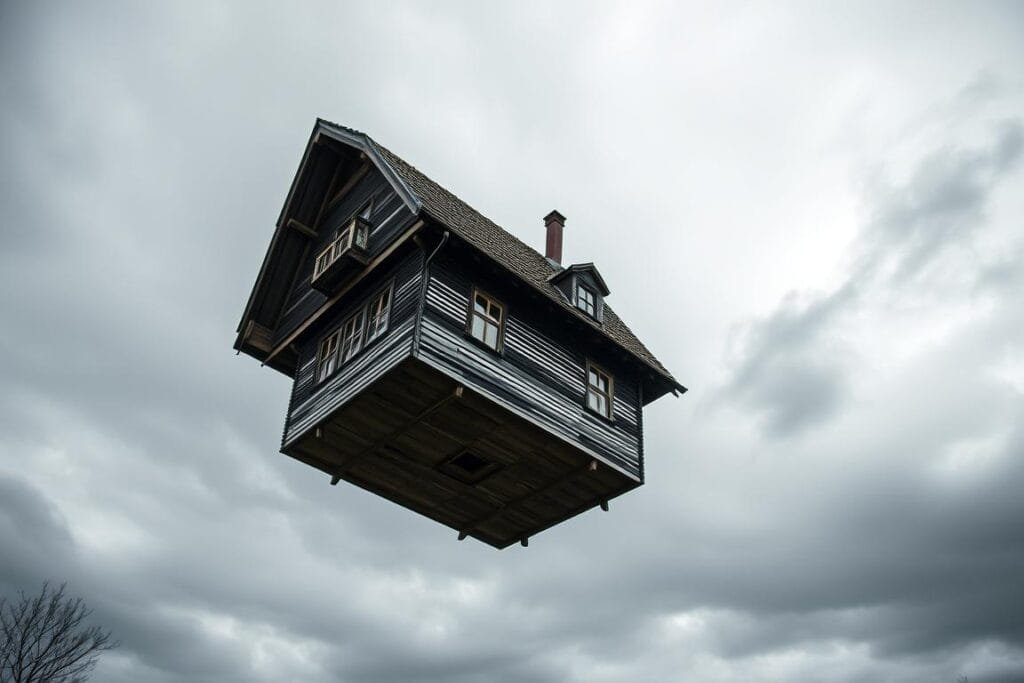
In Szymbark, Poland, businessman Daniel Czapiewski built a house upside down in 2007. Its furniture hangs from what looks like the ceiling, and the house is slightly tilted, which makes many visitors feel dizzy inside.
It does not defy gravity, but it shows how strongly our sense of balance depends on what we see.
Other Strange Illusions
The Reverse Waterfall at Naneghat, India
During the monsoon, strong winds at Naneghat in Maharashtra push water from a waterfall back up into the air, so it looks as if the water is flowing upward. This is caused by wind, not by any change in gravity.
Is Gravity Really the Same Everywhere?

Real gravity anomalies do exist, but they are tiny. Gravity is slightly weaker at the equator than at the poles, and satellites such as NASA’s GRACE mission have mapped small differences caused by mountains, ocean trenches and the movement of rock deep inside the Earth.
The Hudson Bay region of Canada, for example, has slightly lower gravity than its surroundings, partly because the land is still slowly rising after the weight of Ice Age glaciers was removed. These differences are far too small to make a car roll uphill.
The Bermuda Triangle: Disappearances, Myths and What Science Says
Conclusion
Gravity hills and mystery spots do not break the laws of physics, but they reveal how much our perception depends on the world around us. That is exactly what makes them so much fun to visit.
FAQ
What is a gravity hill?
A gravity hill is a place where a slight downhill slope looks like an uphill one, so cars and balls seem to roll uphill.
Are these gravity-defying locations real?
The places are real, but gravity works normally there. The effect is an optical illusion created by the landscape.
Is Magnetic Hill in Ladakh really magnetic?
No. The effect is an optical illusion caused by the surrounding mountains, which hide the true horizon.
Does gravity vary around the world?
Yes, slightly. It is a little weaker at the equator and varies with mountains and rock density, but the differences are far too small to notice.