
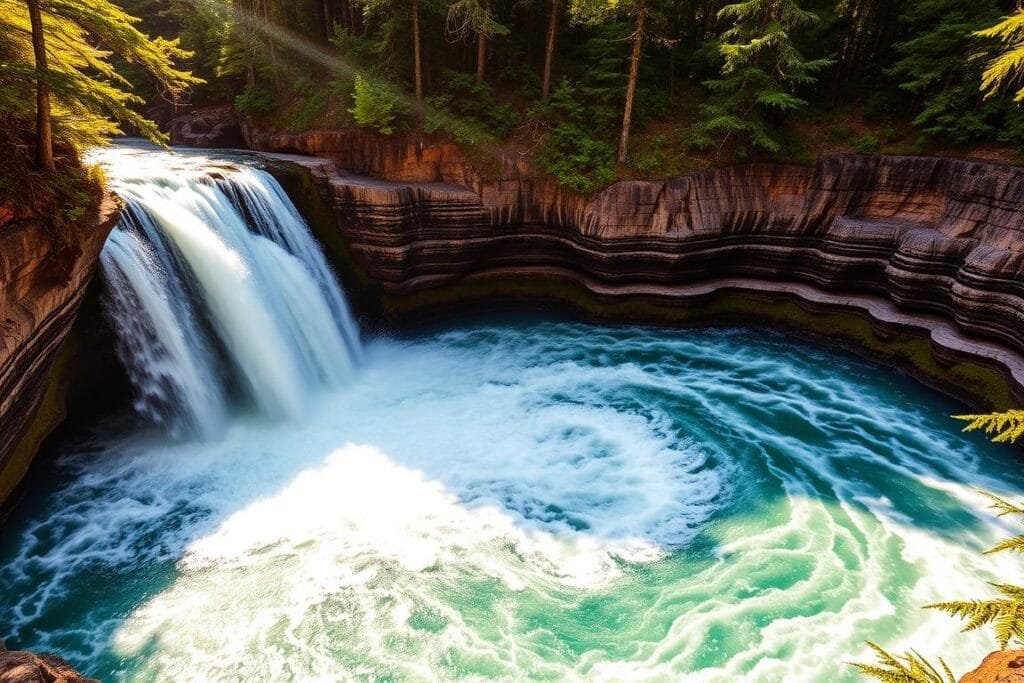
In Minnesota’s North Shore wilderness, a waterfall puzzled visitors for generations. At the Devil’s Kettle, in Judge C.R. Magney State Park, the Brule River splits around a rock outcrop. One side drops into a pool below, while the other plunges into a deep pothole and seems to disappear.
For decades, people asked where that water went. Stories claimed that sticks, ping-pong balls and other objects thrown into the kettle never came back. In 2016, hydrologists finally offered a convincing answer.
Key Takeaways
- Devil’s Kettle is in Judge C.R. Magney State Park, near Lake Superior in northeastern Minnesota
- Half of the Brule River seems to vanish into a pothole in the rock
- In 2016, Minnesota DNR hydrologists measured almost the same flow above and below the falls
- The water most likely rejoins the river in the plunge pool just below the kettle
- The hike is a bit over 2 miles round trip, with many stairs
Introduction to the Devil’s Kettle
Judge C.R. Magney State Park lies on Minnesota’s North Shore, about 14 miles northeast of Grand Marais. It covers roughly 4,600 acres of boreal forest around the lower Brule River.
A Unique Waterfall
Just upstream of Lake Superior, the Brule River meets a knob of volcanic rock and splits in two. One channel forms a normal waterfall, while the other pours into a round hole, the Devil’s Kettle, and its water cannot be seen leaving.
Geological Setting
The North Shore is built from ancient volcanic rock, mostly basalt and rhyolite, formed about 1.1 billion years ago. Over its last few miles, the Brule River drops steeply toward Lake Superior, creating a series of falls and rapids.
The Science Behind the Devil’s Kettle

The Old Theories
For years, people suggested that the water flowed through an underground tunnel or a cave, possibly emerging in Lake Superior. Geologists doubted this, because the rhyolite in the area does not form large caves or lava tubes.
The 2016 Measurements
In 2016, Minnesota Department of Natural Resources hydrologists Jeff Green and Calvin Alexander measured the river’s flow just above the split and below the falls. They found that the two measurements were nearly identical, within the margin of error of their instruments.
That result means no significant amount of water is lost. The most likely explanation is that the water from the kettle simply rises back into the plunge pool directly below, where it mixes with the rest of the river.
The Devil’s Kettle shows that some long-standing mysteries can be solved with simple, careful measurements.
Why Objects “Disappear”
The stories about objects never returning are probably explained by the plunge pool itself. Strong turbulent currents can hold objects underwater, break them apart or release them later downstream, where nobody is watching for them.
The researchers suggested a dye test could confirm their conclusion, but it was not needed to show that the water returns to the river.
Visiting the Devil’s Kettle

The trail to the falls starts near the park entrance on Highway 61. It is a bit over 2 miles round trip and includes a long staircase of roughly 180 steps down into the river gorge, which you must climb back up on the way out.
Best Times to Visit
- Spring: high water from snowmelt makes the falls most powerful
- Fall: the forest colors are spectacular
- Summer: warm weather and the busiest season
- Winter: icy, quiet and beautiful, but only for prepared hikers
What to Bring
- Good hiking shoes with traction
- Water and snacks
- A Minnesota state park vehicle permit
- A camera
Safety Considerations
The gorge can be dangerous. Rocks near the water are slippery, the current is strong and the cliffs are steep.
- Stay on the marked trail and viewing areas
- Never try to climb down to the kettle or enter the river
- Check the weather and trail conditions before you go
- Tell someone your plans, especially in winter
Environmental Impact

The falls are popular, so visitors can help protect them by following Leave No Trace principles: stay on the trail, pack out trash and do not throw objects into the kettle.
Local Myths and Legends
For decades, the Devil’s Kettle inspired tall tales. People claimed that ping-pong balls, logs and even a car had been thrown in and never seen again, and some said the water traveled underground all the way to Lake Superior.
None of these stories was ever confirmed. The 2016 measurements showed that the simplest explanation fits best: the water never really leaves the river.
The Bermuda Triangle: Disappearances, Myths and What Science Says
Conclusion
The Devil’s Kettle is a reminder that some natural mysteries have elegant answers. Even with its secret explained, the waterfall remains a striking sight and one of the most popular hikes on Minnesota’s North Shore.
FAQ
What exactly is the Devil’s Kettle?
The Devil’s Kettle is a waterfall on the Brule River in Judge C.R. Magney State Park, Minnesota, where half the river falls into a deep pothole and seems to vanish.
Where does the water go?
In 2016, Minnesota DNR hydrologists found nearly identical flows above and below the falls. The water most likely rejoins the river in the pool just below the kettle.
How difficult is the hike to the Devil’s Kettle?
It is a bit over 2 miles round trip with a long staircase of about 180 steps. It is moderate but tiring on the way back up.
Is it safe to get close to the kettle?
No. View it from the trail and platforms. The rocks are slippery and the current is dangerous.