
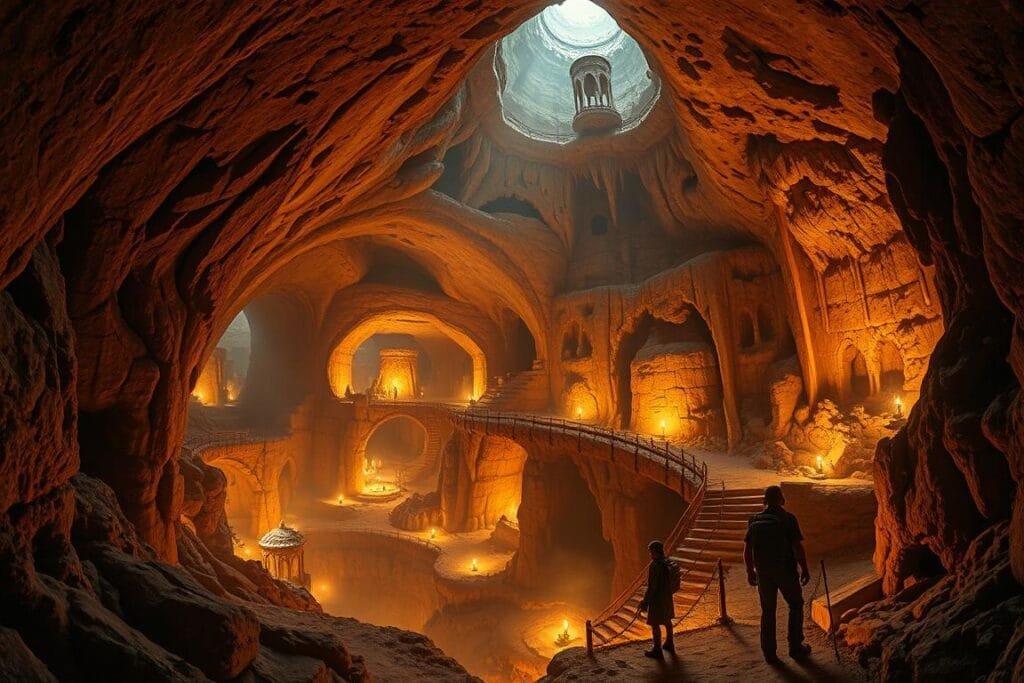
Imagine finding a whole city hidden under your feet. In 1963, a resident of Derinkuyu, Turkey, knocked down a wall in his house and found a passage leading to an underground city that may once have sheltered thousands of people. These underground places are not just old ruins. They show how people survived and how clever they were.
For years, explorers and historians have been fascinated by underground cities and tunnels. In China, archaeologists have found tunnels at the Houchengzui Stone City that are roughly 4,300 to 4,500 years old.
The Houchengzui site covers about 1.38 million square meters, and its tunnels run between 1.5 and 6 meters below the surface. Each find helps us learn more about how our ancestors built safe places under the ground.
Key Takeaways
- Some underground cities could shelter thousands of people
- Some tunnel networks date back more than 4,000 years
- Archaeological sites reveal complex defense systems
- Subterranean structures showcase remarkable engineering
- Hidden tunnels provide insights into ancient survival strategies
The Enigma of Underground Cities and Hidden Tunnels: What Lies Beneath?

Under our feet lies a world of hidden spaces. Underground cities show us how clever humans can be. These places have served as safe havens, storage areas and refuges from danger.
Picture whole communities living in rock, with systems for air, water and food. From old mines to secret tunnels and tombs, these places tell stories of human strength and creativity.
The Birth of Underground Settlements
Underground cities were built for practical reasons:
- Protection from enemy attacks
- Shelter from extreme heat and cold
- Safe storage of food and goods
- Stable temperatures all year round
Historical Significance of Subterranean Settlements
Derinkuyu in Cappadocia, Turkey, is the most famous example. Estimates suggest it could hold around 20,000 people, along with their livestock and food stores. It has:
- Many underground levels, with about 85 meters (280 feet) of depth
- Around 50 ventilation shafts
- Wells, stables, chapels and storage rooms
- Heavy rolling stone doors to block passages
These underground cities are more than shelters. They show the technical skills of the people who carved them and how they protected themselves during wars.
Famous Underground Cities Around the World
Our planet is home to amazing underground spaces, from ancient shelters to modern cities below ground.
Derinkuyu: The Depths of Cappadocia
Derinkuyu’s first chambers may have been dug as early as the 8th to 7th century BCE, and the city was expanded over many centuries, especially during the Byzantine era. It shows remarkable engineering:
- About 50 ventilation shafts that bring air to the lower levels
- Low ceilings and narrow passages for defense
- Wells and water management systems
Montreal’s RESO: An Urban Marvel
Montreal’s RESO is a modern example. This network of tunnels connects shopping centers, metro stations and office buildings, letting people move around the city center without going outside in winter.
The Catacombs of Paris: A Journey Through Time
The Catacombs of Paris hold the remains of millions of people. They were created in the late 18th century, when overcrowded cemeteries were emptied into old limestone quarries under the city.
The Architecture of Hidden Tunnels
Subterranean structures have fascinated people for ages. Underground tunnels are more than passages; they are engineering achievements found in many cultures.

Ancient builders created secret passages for defense, storage and travel.
Engineering Techniques in Ancient Times
Researchers have found impressive engineering methods:
- Ventilation systems with vertical air shafts
- Structural support using local stone
- Branching tunnel layouts that slowed down intruders
- Water management techniques
Purpose Behind Tunnel Systems
| Location | Tunnel Characteristics | Primary Purpose |
|---|---|---|
| Derinkuyu, Turkey | About 85 m deep, many levels | Protection and shelter |
| Erdstall tunnels, Central Europe | Narrow tunnels tens of meters long, about 40-70 cm wide | Unknown; ritual or hiding places |
| Gibraltar | Military tunnels inside the Rock | Military defense |
Exploring these secret passages gives us a peek into human adaptability and architectural genius.
Rediscovering Lost Histories Through Excavation
New archaeological finds are changing how we see hidden underground structures that remained unknown for thousands of years.

Modern technology lets researchers find hidden structures without digging. Ground-penetrating radar and laser mapping are key tools.
Important Archaeological Finds
- The Houchengzui Stone City in Inner Mongolia, China, with tunnels about 4,300 to 4,500 years old
- Dozens of underground cities in Cappadocia, Turkey
- Hidden tunnel systems in Europe and the Americas
Technology’s Impact on Exploration
| Technology | Archaeological Impact |
|---|---|
| Ground-Penetrating Radar | Reveals underground structures without digging |
| Lidar Scanning | Revealed more than 6,000 hidden Maya structures in Campeche, Mexico, in 2024 |
| 3D Mapping | Creates detailed maps of underground cities |
Discoveries like these sometimes fuel conspiracy theories, but they are best explained by careful archaeology that keeps revealing new details about the past.
Preserving the Past: Challenges and Initiatives
Protecting historic underground sites while letting people visit them is a constant balancing act. Climate control, digital records and managed tours help keep these places safe.
At sites like Derinkuyu, conservation teams monitor the structures to limit damage from humidity and visitors. Tourism provides funding and awareness, and tours of places like Sacramento’s underground show how careful visits can help preserve them.
Virtual tours offer another way to explore these places without harming them. By saving them, we make sure future generations can learn from the history hidden under our feet.
FAQ
What exactly are underground cities?
Underground cities are large networks of rooms and tunnels carved into rock. They served as protection from invaders and harsh weather, and some could shelter thousands of people with systems for air, water and storage.
Why did ancient civilizations build underground cities?
They built them for survival and protection. Underground spaces offered defense against enemies, shelter from extreme climates and a stable temperature for storing food.
How were these underground cities constructed without modern technology?
Builders carved them by hand, taking advantage of soft volcanic rock in places like Cappadocia. They added ventilation shafts, wells and stone doors using simple tools and careful planning.
Are there any undiscovered underground cities?
Very likely. New sites are still found, especially in Turkey, where a large underground city was discovered in Nevşehir in 2014. Ground-penetrating radar helps reveal hidden structures.
Can tourists visit these underground cities?
Yes, many are open to visitors. Derinkuyu and Kaymaklı in Turkey are the most famous. Access is managed to prevent damage, and only part of each site is usually open.
What is the largest known underground city?
Derinkuyu in Cappadocia, Turkey, is one of the largest excavated underground cities. It is about 85 meters deep and may have held around 20,000 people.
Source Links
- Archaeology Magazine: Tunnels in an ancient stone city in China
- Discover Magazine: 5 ancient cities built underground
- Atlas Obscura: Derinkuyu
- Big Think: Derinkuyu underground city
- National Geographic: Underground sites
- History.com: 8 mysterious underground cities
- The Conversation: What lies beneath
- The Sacramento underground