
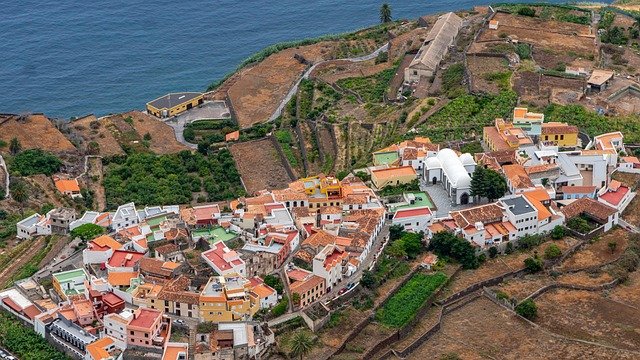
On La Gomera, one of the smaller Canary Islands, deep ravines slice the land into steep valleys. Walking from one farm to the next can take an hour, even when the two are within sight of each other. For centuries, islanders solved that problem in a surprising way: they did not walk, and they did not shout. They whistled, and the whistles carried whole sentences.
This whistled form of Spanish is called Silbo Gomero. It is not a code of signals like “come here” or “danger,” but a way of transposing ordinary speech into whistles, so that skilled users can, in principle, say anything. Today it is taught in the island’s schools and recognized by UNESCO. It is also a window into one of the world’s most unusual ways of communicating, and into how flexible the human brain is when it comes to language.
What Exactly Is Silbo Gomero?
Silbo Gomero (from the Spanish silbar, “to whistle”) is best described as a whistled register of Spanish rather than a separate language. A whistler takes the Spanish sentence they want to say and reproduces its sound patterns with whistles. A listener who knows the system decodes the whistles back into Spanish words.
Whistling cannot reproduce everything the voice does, so the system simplifies speech. The distinctions are made mainly through changes in pitch and through whether a whistle is continuous or broken. According to UNESCO’s description, the five Spanish vowels are represented by two distinct whistles and the consonants by four. Linguists have debated the exact numbers for decades, and some more recent analyses argue that expert whistlers distinguish more vowel sounds than that. What everyone agrees on is that context does a lot of the work: because one whistle can stand for several sounds, listeners rely on the topic of conversation and the shape of the whole sentence to fill in the gaps.
How it is produced
Whistlers use the tongue, lips and hands to shape and project the sound, and mastering the precise changes in pitch and timing takes years of practice. Local tourism authorities say the sound could historically carry for up to about five kilometers across the island’s ravines.
Where Did It Come From?
Roots before the Spanish conquest
Whistled communication on the Canary Islands predates the arrival of the Spanish. It was used by the islands’ original inhabitants, often referred to as Guanches, and similar whistled speech was also reported on other islands, including El Hierro, Tenerife and Gran Canaria. What those earlier whistled systems sounded like, and which language they encoded, is not well documented.
Adapted to Spanish
After Spanish settlement in the fifteenth and sixteenth centuries, the whistling tradition was adapted to Castilian Spanish, the language of the new population. It remained widely used by shepherds and farmers who needed to send messages across valleys: warnings, requests for help, news of a lost animal, or invitations to a celebration. While whistling on the other islands gradually faded, La Gomera became its main stronghold.
Near Extinction and a Remarkable Revival
In the mid-twentieth century, Silbo Gomero went into steep decline. Economic hardship in the 1950s pushed many islanders to emigrate, and new roads and later telephones made long-distance whistling less necessary. From the 1960s onward, whistling became associated with rural poverty, and many families stopped passing it on to their children. By the end of the century, the number of fluent young whistlers had dropped sharply.
The turnaround started from the ground up, with community members offering voluntary lessons. Political support followed. In 1997 the Parliament of the Canary Islands backed including Silbo in the school curriculum, and from 1999 it became a compulsory subject in primary and secondary schools on La Gomera. The island also set up a school to train advanced whistlers and future teachers.
In 2009, UNESCO inscribed “the whistled language of the island of La Gomera” on its Representative List of the Intangible Cultural Heritage of Humanity. UNESCO describes it as the only fully developed whistled language practised by a large community, which on La Gomera numbers more than 22,000 people. Today, children learn it in class, and whistlers perform it at festivals, ceremonies and demonstrations for visitors.
What the Brain Does With Whistled Words
Silbo Gomero has attracted neuroscientists because it poses a neat question: if language arrives as whistles instead of speech, does the brain still treat it as language?
In a study published in Nature in 2005, a team led by David Corina of the University of Washington and Manuel Carreiras of the University of La Laguna used functional MRI to scan the brains of five experienced whistlers and five Spanish speakers who did not know Silbo. When the whistlers listened to Silbo sentences, brain regions in the left hemisphere normally involved in understanding and producing language became active. In the Spanish speakers who did not know the system, the same whistles did not activate typical language areas; to them, it was just whistling.
The researchers concluded that the brain’s language network is flexible enough to process a non-spoken signal as language once it has been learned. It is a small study, but it fits a wider body of evidence showing that language in the brain is defined more by structure and meaning than by the specific sounds or gestures that carry it.
A twist from Turkey
Whistled speech has also challenged a classic idea about brain asymmetry. In 2015, biopsychologist Onur Güntürkün of Ruhr University Bochum and colleagues tested 31 fluent whistlers of Turkish from the village of Kuşköy, in northeastern Turkey, using a listening test that plays different syllables into each ear at the same time. With spoken Turkish, participants showed the usual left-hemisphere advantage. With whistled Turkish, both ears, and therefore both hemispheres, contributed roughly equally. The study, published in Current Biology, suggested that the physical form of a language can shape how the brain processes it.
Not Just La Gomera: Whistled Speech Around the World
Silbo Gomero is the best-known example, but far from the only one. Researchers who study whistled speech, such as linguist Julien Meyer, have documented whistled forms of local languages in at least 80 cultures. They tend to appear in rugged mountains or dense forests, where people live scattered across difficult terrain and need to communicate over distance.
Some of the reasons whistling works so well over distance are physical:
- Skilled whistlers can produce sounds of roughly 120 decibels, concentrated in a frequency range of about 1 to 4 kilohertz that stands out against natural background noise.
- Whistled speech remains intelligible at distances many times greater than ordinary speech or even shouting: on the order of a kilometer or more, versus roughly 200 meters for a shout and about 40 meters for normal conversation, according to field measurements summarized by Knowable Magazine.
- Experienced listeners of whistled Turkish have been found to recognize around 70 percent of isolated whistled words, rising to roughly 80 to 90 percent when words appear in familiar sentences.
Tonal versus non-tonal languages
How a language is whistled depends on how it works. In non-tonal languages like Spanish or Turkish, whistlers imitate the way vowels and consonants change the timbre of the voice, mapping those changes onto pitch. In tonal languages, where pitch itself changes the meaning of a word, whistlers usually follow the tones of speech instead. Languages with rich tonal systems, such as some varieties of Hmong and the Chinantec languages of Mexico, can carry a surprising amount of meaning this way, while languages with simpler tone systems often rely on a smaller set of familiar phrases.
A shared threat
Many whistled traditions are fading. Roads, mobile phones and changing ways of life reduce the need to talk across valleys, and in some forest regions deforestation has removed the setting in which whistling made sense. The whistled form of the Tepehua language of Mexico, for example, has already disappeared. In 2017 UNESCO added the whistled Turkish of the Black Sea region to its list of intangible heritage in need of urgent safeguarding, a sign of how vulnerable these traditions are.
Facts, Debates and Myths
- Established: Silbo Gomero is a whistled form of Spanish, taught as a compulsory school subject on La Gomera since 1999 and recognized by UNESCO since 2009.
- Established: brain imaging shows that trained whistlers process Silbo using language areas of the brain.
- Debated: exactly how many distinct vowel and consonant whistles the system has; estimates differ between researchers.
- Uncertain: how the pre-Spanish whistled systems of the Canary Islands worked and which language they encoded.
- Myth: that Silbo is a secret code or a separate language unrelated to Spanish. It is a way of whistling Spanish itself.
Hearing It for Yourself
Visitors to La Gomera can often hear Silbo at cultural events and demonstrations, and the island promotes it as a core part of its identity. Even if you never travel there, recordings make one thing clear within seconds: what sounds at first like birdsong is, to the trained ear, perfectly ordinary conversation.
Why It Matters
Silbo Gomero shows that language is not tied to the vocal cords. Given the right landscape and enough need, people can carry the full richness of speech in a whistle, and the brain will happily treat it as language. Its revival also shows that a tradition close to disappearing can be brought back when a community, its schools and its institutions decide it is worth keeping. In a world where whistled languages are quietly vanishing, La Gomera offers both a warning and a model.
Sources
- UNESCO – Whistled language of the island of La Gomera (Canary Islands), the Silbo Gomero
- University of Washington News – Shepherds whistle while they work, and brains process sounds as language (2005)
- Knowable Magazine – Speaking in whistles (2021)
- PBS NOVA Next – Whistled “bird language” uses both sides of the brain (2015)
- UNESCO – Whistled language (Türkiye), Urgent Safeguarding List
- La Gomera Tourism – Silbo gomero, the whistling language of La Gomera
- Silbo Gomero – Wikipedia (overview and references)