
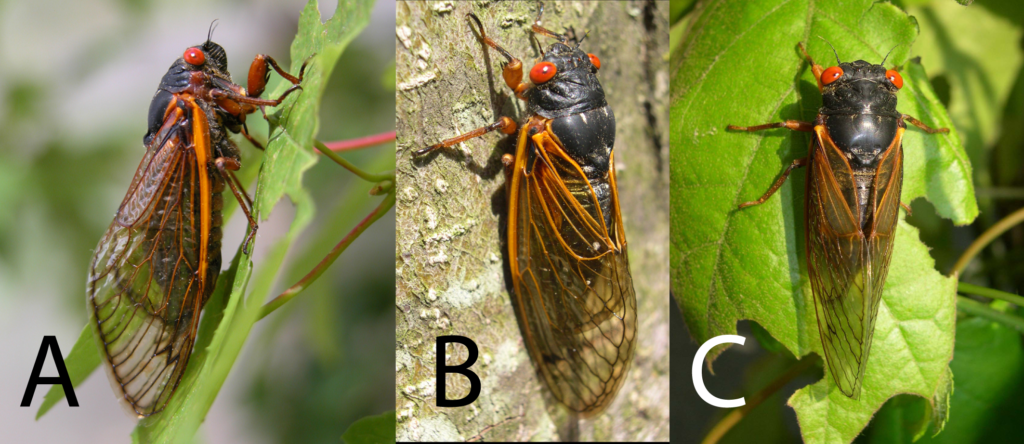
Most insects live for weeks or months. Periodical cicadas spend 13 or 17 years in total darkness, sipping fluid from tree roots, and then, within a few spring weeks, millions of them climb out of the soil at once, shed their skins, sing, mate and die. Then the forest goes quiet again for more than a decade.
Two questions have puzzled biologists for well over a century. How does an insect underground keep track of the years with such precision? And why those particular numbers? Thirteen and 17 are both prime numbers, divisible only by 1 and themselves, and that coincidence has inspired some of the most interesting ideas in evolutionary biology. Here is what researchers know, what they suspect, and what is still open.
What periodical cicadas are
Periodical cicadas belong to the genus Magicicada and are found only in eastern North America. Scientists recognize seven species: four with 13-year life cycles and three with 17-year cycles. They are not the same as the green “annual” or “dog-day” cicadas heard every summer, which also live underground for several years but whose generations overlap, so some adults appear every year.
Periodical cicadas are different because almost every individual in a given area is the same age. Populations that emerge in the same year are grouped into “broods,” numbered with Roman numerals. A 2013 study in the Proceedings of the National Academy of Sciences (PNAS) sampled all 15 broods that still exist. Some broods are famous: Brood X, the “Great Eastern Brood,” is a 17-year brood spread across 15 states and Washington, D.C.
Life underground
After hatching from eggs laid in tree twigs, the tiny nymphs drop to the ground, burrow down and attach themselves to roots. They spend almost their whole lives there, feeding on the watery sap that trees move up from their roots. When the final year arrives, they tunnel up and wait for the right conditions. Emergence usually begins in spring once the soil warms to roughly 64°F (about 18°C).
How do cicadas count the years?
Soil temperature explains which week the cicadas come out, but not which year. For that, a nymph needs some way to tell that 13 or 17 years have passed.
The best evidence so far comes from an experiment published in 2000 by Richard Karban of the University of California, Davis, and colleagues. Their idea was that nymphs do not count time with an internal clock alone but read seasonal signals from the tree they feed on. Karban suspected that the yearly surge of sugars and proteins moving through a tree’s roots around flowering time acts as that signal.
To test this, the researchers placed 17-year cicada nymphs that were about 15 years old on the roots of peach trees in a controlled environment. By manipulating the light, they made the trees flower twice in a single year. The result: the cicadas emerged a year earlier than expected, as if they had “counted” the extra tree cycle as an extra year.
This supports the idea that cicadas count annual cycles in their host trees rather than days or temperatures. What it does not reveal is the exact mechanism inside the insect, which remains an open research question.
Why emerge all at once? Predator satiation
The most widely accepted explanation for mass emergence itself is called predator satiation. Birds, squirrels, raccoons and many other animals eat cicadas eagerly, but when an enormous number of them appear in a short window, predators simply cannot eat them all. They get full long before they make a dent, and the survivors reproduce.
The long gap between emergences adds a second layer of protection. No predator can specialize in periodical cicadas, because for most of a decade there is nothing to eat. A bird population cannot grow in step with a food source that shows up once every 13 or 17 years.
Predator satiation is well supported, but it explains synchrony and long cycles in general. It does not, on its own, explain why the cycle lengths are 13 and 17 rather than, say, 12 or 15. That is where the prime-number theories come in.
Why 13 and 17? Three leading theories
It is important to be clear: none of the following explanations is proven. Each is a hypothesis with supporting arguments and known weaknesses, and some researchers suspect several factors worked together.
Theory 1: Dodging predators and parasites with their own cycles
Many predator and parasite populations rise and fall over a few years. Imagine a cicada with a 12-year cycle. Its emergence would line up every single time with any enemy whose population peaks every 1, 2, 3, 4, 6 or 12 years, because all of those numbers divide evenly into 12. A cicada on a 13-year cycle lines up every time only with an enemy on a 1-year or 13-year cycle. A predator with a 4-year cycle, for example, would coincide with it only once every 52 years.
Biologists Monte Lloyd and Henry Dybas were among the first to discuss this logic, in the 1960s, and later mathematical models explored it further. In 2001, a team including researchers from the Max Planck Institute of Molecular Physiology in Germany and the University of Chile reported a predator–prey model in which prime-numbered cycles emerged on their own. Mathematician Glenn Webb published a model the same year in which 13- and 17-year cycles kept populations stable while non-prime cycles such as 12 or 18 years led to decline.
The weakness: no one has identified a real predator or parasite with the short, regular cycle the theory requires. Cicada researcher Chris Simon of the University of Connecticut has pointed out that the idea is very hard to test. Others note that most of the world’s cicada species are not periodical at all, even though they face predators too.
Theory 2: Avoiding mixing with other broods
A second idea focuses on cicadas themselves. If broods with different cycle lengths emerged together often, they could interbreed, and their offspring might end up with mismatched, in-between cycles. Those hybrids would emerge in small numbers, out of sync with everyone else, and be picked off by predators because there would be too few of them to satiate anyone.
Prime numbers minimize these encounters. A 13-year and a 17-year brood living side by side meet only once every 221 years (13 × 17). Researchers Randel Tom Cox and C. E. Carlton have argued for versions of this idea, including in a 1998 commentary in The American Naturalist.
The weakness: most broods live in separate geographic areas, so many of them would rarely meet anyway, and critics argue this reduces the pressure the theory relies on.
Theory 3: Surviving the Ice Ages
Japanese biologist Jin Yoshimura proposed in 1997 that the cycles took shape during the cold periods of the Pleistocene. Cooler soil would slow nymph development, stretching life cycles. In a sparse, chilly landscape, a cicada that emerged in a small group would struggle to find a mate, a problem ecologists call an Allee effect. Long, tightly synchronized cycles would help ensure that enough adults appeared together to reproduce, and prime-numbered cycles would reduce disruptive overlap between groups.
Genetic data have added nuance. The 2013 PNAS study, co-authored by Yoshimura, Simon and others, found that 13- and 17-year cycles split apart independently in three separate lineages of periodical cicadas, and that these splits are linked to climate swings since the middle Pleistocene. However, the study also suggested that the three main species groups themselves are older than the glacial periods, so the Ice Ages may have shaped the cycles rather than created periodical cicadas from scratch.
A twist: the four-year shift
One detail complicates the tidy prime-number story. The difference between the two cycles is exactly four years, and researchers have documented groups of cicadas emerging four years earlier or later than their brood, suggesting that development can shift by exactly that amount. Simon and colleagues have suggested this four-year flexibility may be at least as important to the cicadas’ history as the fact that 13 and 17 happen to be prime. In their view, it is still uncertain whether primality is a real evolutionary advantage or a striking coincidence.
When the cycles meet: the 221-year event
The math is not just theoretical. In spring 2024, Brood XIII (the 13-year “Northern Illinois Brood”) and Brood XIX (the 17-year “Great Southern Brood”) emerged in the same season. According to the Smithsonian, the last time these two broods came out together was 1803, when Thomas Jefferson was president, and the next time will be in 2245. Their ranges overlap only in a small area, mainly in central Illinois, but together the two broods were estimated to involve more than a trillion insects across about 16 states.
Events like this give scientists a rare chance to study the contact zones where different broods meet and possibly interbreed, which bears directly on Theory 2 above.
The enemy that cracked the code
Even a prime-numbered schedule has not protected cicadas from everything. A fungus called Massospora infects cicadas as they emerge. It replaces part of the cicada’s abdomen with a mass of spores, yet the insect keeps flying and trying to mate, spreading the fungus as it goes. Researchers have found that the fungus produces cathinone, an amphetamine-like compound, and that infected males can behave like females, attracting more males and spreading spores further.
What we know, and what we don’t
- Established: There are seven Magicicada species with 13- or 17-year cycles, grouped into 15 surviving broods. They emerge in mass when the soil warms to around 64°F.
- Strong evidence: Mass emergence protects cicadas through predator satiation. Nymphs appear to count years by tracking seasonal cycles in their host trees.
- Debated theories: Prime-numbered cycles may help avoid predators with shorter cycles, limit mixing between broods, or reflect survival during Ice Age climate swings. None is confirmed.
- Open questions: the internal “counter” inside the nymph, and whether primality is an advantage or a coincidence.
Periodical cicadas are a reminder that nature sometimes runs on schedules far longer than our own planning horizons. The next time a brood emerges near you, the insects climbing the tree trunks will have spent more than a decade quietly counting, and scientists are still working out exactly how.
Sources
- Sota, T. et al. (2013). Independent divergence of 13- and 17-y life cycles among three periodical cicada lineages. PNAS 110(17).
- Scientific American: The 17-Year Itch
- Scientific American: Deciphering the Strange Mathematics of Cicadas
- Smithsonian Magazine: Cicadas Are Coming: Rare Dual Emergence Could Bring One Trillion of the Bugs
- The Christian Science Monitor: Cicadas return: How do they know when it’s time to emerge?
- Live Science: Prime numbers protect Brood X cicadas from everything but zombie fungus
- Cox, R. T. & Carlton, C. E. (1998). A commentary on prime numbers and life cycles of periodical cicadas. The American Naturalist 152(1).