
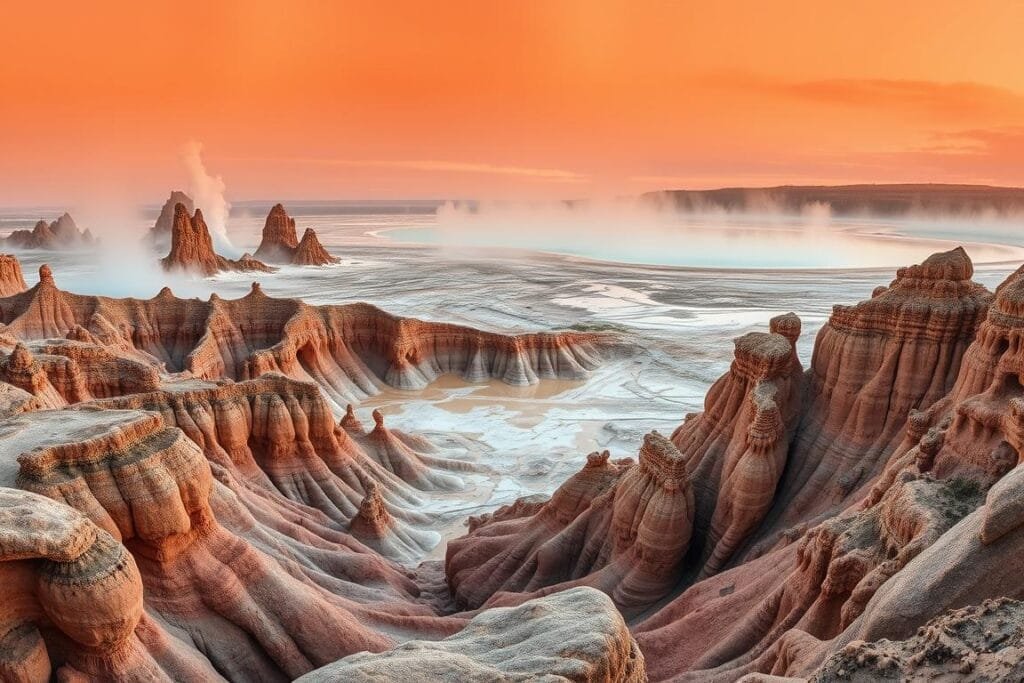
Imagine a world where waterfalls run blood-red, stones glide across desert floors and bays glow at night. Our planet is full of geological wonders that challenge our understanding of nature. In California’s Racetrack Playa, for example, heavy stones leave long trails across the dry lake bed. Events like these show that Earth is a treasure trove of unusual natural phenomena.
In this journey through the world’s strangest natural phenomena, we’ll explore landscapes and events that seem like science fiction, and the science that explains them.
Key Takeaways
- Discover extraordinary natural phenomena from around the globe
- Explore geological wonders that once puzzled scientists
- Learn about rare and unexpected environmental conditions
- Understand the science behind bizarre natural events
- Appreciate the incredible diversity of Earth’s landscapes
The Mysterious Sailing Stones of Death Valley
Imagine a place where rocks move on their own, sliding across the desert. This is Racetrack Playa in Death Valley National Park, home to one of the world’s most famous natural puzzles.

For decades, scientists and visitors were baffled by these rocks. Some weigh more than 30 kilograms and leave long trails on the dry lake bed. It looks like magic.
Unveiling the Sailing Stone Mystery
Researchers tried to figure out how these stones moved for decades. The answer came in 2014, when a team using GPS-tracked stones and time-lapse cameras finally watched them move.
- Most stones range from 15 to 46 cm in diameter
- Movements are rare and happen only in certain winters
- Tracks can last for years
The Scientific Explanation
The stones move during a rare winter combination. Rain creates a shallow pond, cold nights freeze it into a thin ice sheet, and when the ice breaks up on sunny days, light winds push the floating ice panels against the stones.
| Movement Characteristic | Details |
|---|---|
| Maximum Distance Observed | 224 meters |
| Movement Speed | A few meters per minute |
| Typical Movement Duration | Seconds to about 16 minutes |
On December 20, 2013, researchers observed more than 60 rocks moving at once, a breakthrough in understanding these mysterious natural occurrences.
The Incredible Bioluminescence of Mosquito Bay
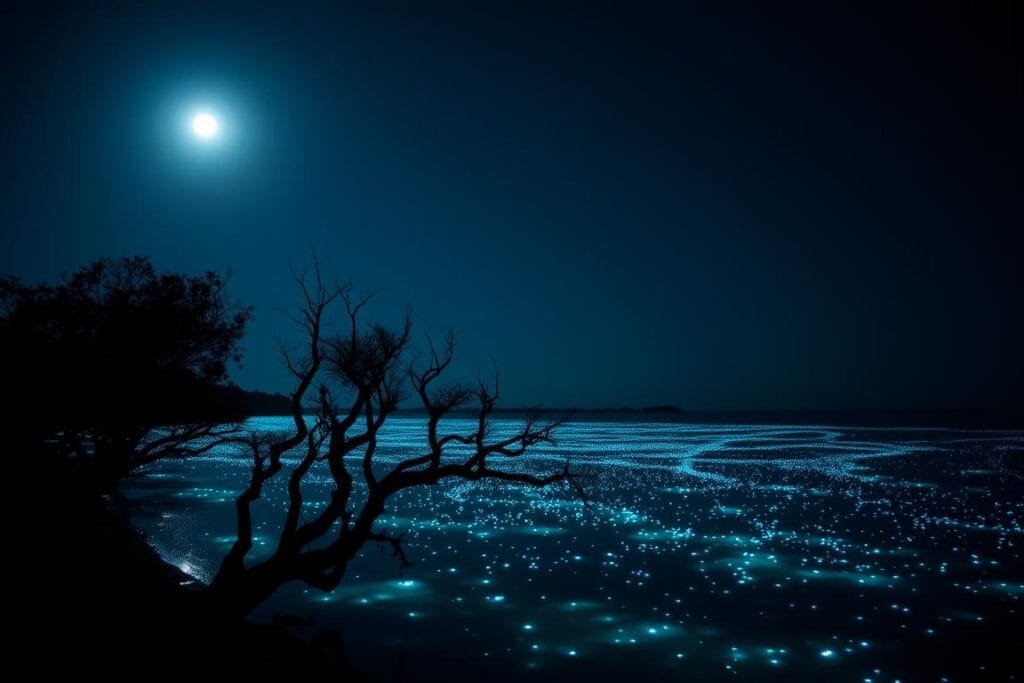
Imagine swimming in a sea of living light. Mosquito Bay on the island of Vieques, Puerto Rico, offers this magical experience. It’s a world-renowned spot for an ecosystem that glows with blue-green light.
The Science Behind the Magical Glow
Under Mosquito Bay’s surface, a microscopic light show happens. Huge numbers of tiny dinoflagellates live in the water and light up through a chemical reaction whenever they are disturbed.
- Hundreds of thousands of dinoflagellates can live in a single gallon of water
- Recognized as the brightest bioluminescent bay by Guinness World Records in 2008
- Unique ecosystem supported by surrounding mangrove trees
When to Experience the Luminous Wonder
Timing is key when exploring this bioluminescent marvel. The bay shines brightest during the new moon phase, when darkness sets the stage for nature’s light show.
Puerto Rico has three bioluminescent bays, with Mosquito Bay being the brightest. Its narrow entrance and protected environment help keep its ecosystem unique.
The Breathtaking Northern Lights
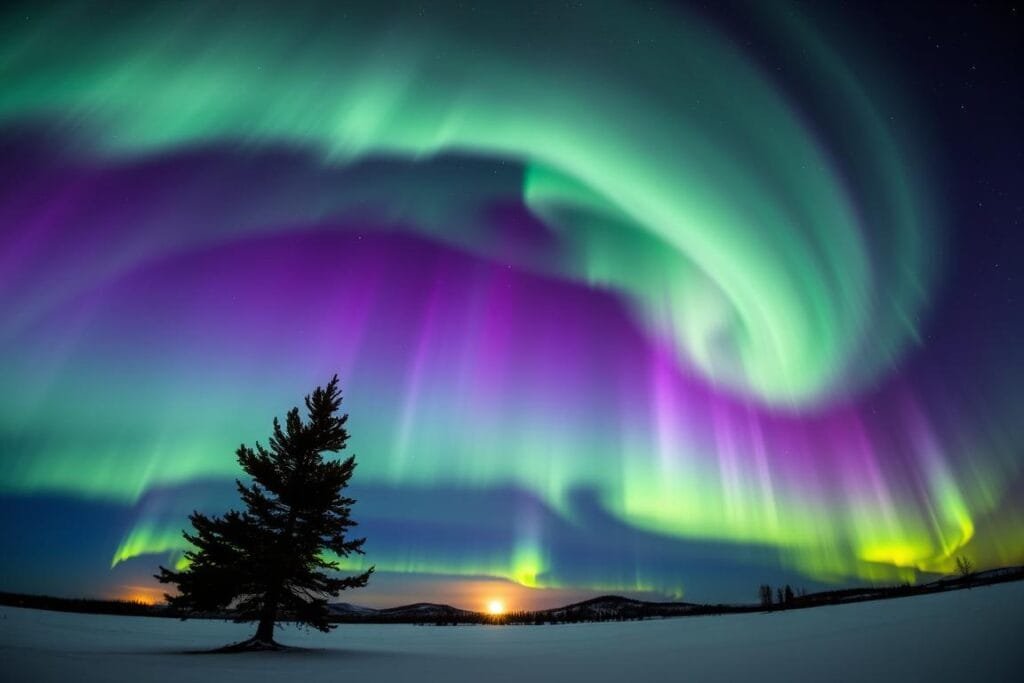
Imagine standing under a dark sky when suddenly, a dance of colors erupts above. The Northern Lights turn ordinary nights into unforgettable moments.
The Cosmic Light Show Explained
These colorful lights happen when charged particles from the Sun hit gases in Earth’s upper atmosphere, guided by the planet’s magnetic field. Most auroras glow about 100 kilometers or more above the ground.
- Best viewed between 6 PM and 1 AM
- Most frequent from September to late March in the far north
- Influenced by solar activity
Where to Witness Nature’s Light Performance
Northern Norway is one of the best places, with spots like Lofoten and Tromsø inside the auroral oval.
Other great spots include:
- Iceland
- Alaska
- Northern Canada
- Greenland
The Most Isolated Tribes in the World: Hidden From Civilization
The Surreal Blood Falls in Antarctica
Antarctica is home to a remarkable sight: Blood Falls, a red outflow staining the white ice of Taylor Glacier in the McMurdo Dry Valleys.
The Mysterious Red Water Phenomenon
So, why is Blood Falls red? Scientists found the reason:
- Very salty water trapped beneath Taylor Glacier for an estimated 1.5 million years or more
- High iron content in that brine
- Oxidation when the iron-rich water reaches the air, turning it red like rust
Scientific Significance and Discovery
Blood Falls is more than just a striking sight. It’s a key to understanding extreme environments.
| Discovery Details | Scientific Insights |
|---|---|
| First described in 1911 by geologist Griffith Taylor | Microbes live in the brine without light or much oxygen |
| Located in McMurdo Dry Valleys | Offers clues about possible life on icy worlds |
| Brine stays liquid below 0 °C because of its salt | Demonstrates unique survival mechanisms of extremophiles |
The Unique Moeraki Boulders of New Zealand
The Moeraki Boulders sit along the Otago coast of New Zealand’s South Island. These almost perfectly round rocks look as if they were made by hand.
Imagine walking on a beach with huge stone balls everywhere. Each boulder took millions of years to form.
Incredible Formation Process
Scientists say the boulders are concretions, formed as minerals slowly built up around a core:
- Formed roughly 60 million years ago
- Created in mud on an ancient sea floor
- Started around a small core
- Grew over several million years
Some are as big as 2 meters across and weigh several tonnes. Erosion of the coastal cliffs gradually exposes them on the beach.
| Characteristic | Details |
|---|---|
| Total Boulders | Dozens on Koekohe Beach |
| Age | Approximately 60 million years |
| Size Range | Up to about 2 meters in diameter |
| Protection Status | Protected scientific reserve |
Ancient Underground Cities and Hidden Tunnels Around the World
Strange Weather Events: The Ball Lightning Phenomenon
Ball lightning is one of the most mysterious weather events. Witnesses describe a glowing sphere floating in the air during a thunderstorm.
This rare phenomenon has fascinated people for centuries. One of the oldest well-known accounts comes from the Great Thunderstorm of Widecombe-in-the-Moor, England, in 1638.
Defining the Phenomenon
Ball lightning is described as a glowing, spherical object that moves through the air during storms. According to witness reports, these orbs can:
- Range from a few centimeters to over 1 meter in diameter
- Typically last a few seconds
- Display colors including blue, orange, and white
- Move horizontally or float through rooms
Scientific Investigations and Theories
Scientists have proposed several explanations:
- In 2006, researchers at Tel Aviv University created glowing fireballs in the lab using microwaves
- In 2012, Chinese scientists recorded the spectrum of a natural ball lightning event for the first time
- Some researchers suggest that a few reports may be hallucinations caused by strong magnetic fields from nearby lightning
Despite all the research, ball lightning remains one of the most enigmatic natural occurrences in atmospheric science.
The Enigmatic Crypt Lake in Canada
Crypt Lake sits in Waterton Lakes National Park, Alberta, and is famous for one of Canada’s most unusual hiking trails.
The path to the lake starts with a boat ride across Upper Waterton Lake and includes a ladder, a short natural tunnel through the rock and a cable-assisted ledge above a steep drop.
People come here for the wilderness and the challenge of getting there. The lake’s clear waters mirror the surrounding peaks, creating stunning views.
FAQ
How do the sailing stones in Death Valley actually move?
The sailing stones move when thin sheets of ice form on a shallow winter pond and then break up. Light winds push the floating ice against the stones, sliding them across the mud.
What causes bioluminescence in Mosquito Bay?
Bioluminescence in Mosquito Bay comes from tiny organisms called dinoflagellates. When disturbed, they produce a blue-green glow through a chemical reaction.
What creates the Northern Lights?
The Northern Lights appear when charged particles from the Sun hit gases in our upper atmosphere. Earth’s magnetic field guides them toward the polar regions, creating light shows in green, pink and other colors.
Why is Blood Falls in Antarctica red?
Blood Falls gets its color from iron-rich brine trapped under Taylor Glacier. When the brine reaches the air, the iron oxidizes and turns red, much like rust.
How were the Moeraki Boulders formed?
The Moeraki Boulders are concretions. Over millions of years, minerals built up around a core in sea-floor mud, and coastal erosion later exposed them on the beach.
What exactly is ball lightning?
Ball lightning is a rare glowing sphere reported during thunderstorms. It lasts only seconds, and scientists still debate what causes it.
Why is Crypt Lake considered unique?
Crypt Lake is special because of the trail that leads to it, which includes a boat ride, a ladder, a short tunnel and a cable-assisted ledge in Waterton Lakes National Park.
Can anyone witness these natural phenomena?
Some, like the Northern Lights or Mosquito Bay, can be seen with good planning and the right season. Others, like ball lightning or moving stones, are rare and unpredictable.
Source Links
- Wikipedia: Sailing stones
- EarthSky: Death Valley sailing stone mystery solved
- Vox: Sailing stones of Death Valley
- Vieques: Bioluminescent Bay
- Visit Norway: Facts about the Northern Lights
- National Geographic: Blood Falls explained
- National Geographic: Ball lightning
- BBC Travel: Where nature plays magic tricks