In the misty forests of the Pacific Northwest, a strange sound echoes through the silence. Famous cryptid sightings like this have long fascinated both adventure seekers and researchers. The field of cryptozoology is a place where folklore, eyewitness stories and scientific skepticism meet.
Across the United States, reports of mysterious creatures keep appearing. These sightings spark heated debates between skeptics and believers. From Washington’s dense woods to Texas ranchland, the stories are vivid, but solid physical evidence has never been found.
This article looks at the best-known cases, what witnesses reported, what evidence exists and why scientists remain unconvinced.
Key Takeaways
- Cryptid sightings continue to intrigue researchers and the public
- Several regions in the United States report unexplained creature encounters
- Scientific investigation remains difficult because of limited physical evidence
- Several famous pieces of evidence were later shown to be hoaxes
- Cryptozoology sits between scientific skepticism and folklore
Introduction to Cryptids and the Mystery Surrounding Them
Cryptozoology takes us into a world of mysterious creatures that challenge our understanding of nature. These unexplained phenomena have fascinated people for generations. They mix myth and the possibility of scientific discovery.
So, what are cryptids? They are creatures whose existence is not proven by science. From huge forest dwellers to mysterious sea creatures, they live on the edge of our knowledge. They spark curiosity and start debates.
- Cryptids challenge traditional scientific boundaries
- They come from cultural folklore and local legends
- Many cryptids have consistent descriptions across different regions
Some well-known cryptids include:
- Bigfoot: The legendary forest giant
- Loch Ness Monster: A legend whose earliest story dates back to the 6th century
- Chupacabra: A creature first reported in Puerto Rico in the 1990s
The mystery of cryptids is what makes them so fascinating. They remind us that the natural world still holds surprises, even if most cryptid stories have ordinary explanations.
Famous Cryptid Sightings in the United States
The world of paranormal encounters is fascinating. Mysterious creatures have long sparked our imagination and curiosity, with reported sightings across the United States.
From dense forests to remote wilderness, these stories intrigue both skeptics and believers.
Bigfoot: The Ever-Elusive Giant of the Forest
Bigfoot is the most iconic cryptid in North American folklore. Wilderness sightings of this massive, ape-like creature persist in Pacific Northwest forests, although no body, bones or confirmed DNA have ever been found.
- Reported sightings concentrated in Washington and Oregon
- Footprint casts remain the most common kind of evidence
- Local communities share generational stories of encounters
Chupacabra: Reports from Texas and Beyond
The Chupacabra sparks intense speculation in the southwestern United States, where it has been linked to livestock attacks. Animals found and examined in Texas have generally turned out to be coyotes or dogs suffering from severe mange.
Mokele-Mbembe: The Dinosaur of the Congo
While not a United States cryptid, Mokele-Mbembe is one of the most famous legends worldwide. Expeditions to Central Africa have searched for this supposed dinosaur-like creature without finding evidence of it.
Paranormal encounters continue to challenge scientific boundaries. Whether Bigfoot, Chupacabra, or other elusive creatures, these stories remind us how powerful folklore can be.
Eyewitness Accounts: Credibility and Patterns
Paranormal encounters have long fascinated researchers. The reliability of eyewitness reports is a big challenge for investigators.
Eyewitness reports often have intriguing details, but they can also be full of inconsistencies. Some investigations have found patterns that help explain these mysterious encounters.
Analysis of Eyewitness Reports
Researchers have found some key insights into eyewitness testimonies:
- Multiple reports sometimes come from the same source
- Descriptions often share similar patterns
- Witness accounts can vary a lot in important details
Common Descriptions and Features
Despite differences, some elements are common in these reports. Witnesses often describe creatures with similar traits, which can reflect shared cultural images as much as real animals. Some reports include multiple creature sightings, while others focus on single encounters.
Psychological Factors in Sightings
The human mind plays a big role in how we see unusual experiences. Investigations have shown that perception can be influenced by expectations, poor lighting and fear. This can turn ordinary animals or shapes into extraordinary claims.
Not every unexplained encounter is a true paranormal event, but not every account can be easily dismissed.
In cryptozoology, researchers keep looking through accounts and seek solid evidence. Their ongoing search shows our deep fascination with the unknown.
Investigative Methods: Approaches to Unsolved Sightings
Cryptid enthusiasts and some scientists use a mix of technology and local investigation to test the stories behind mysterious creatures.
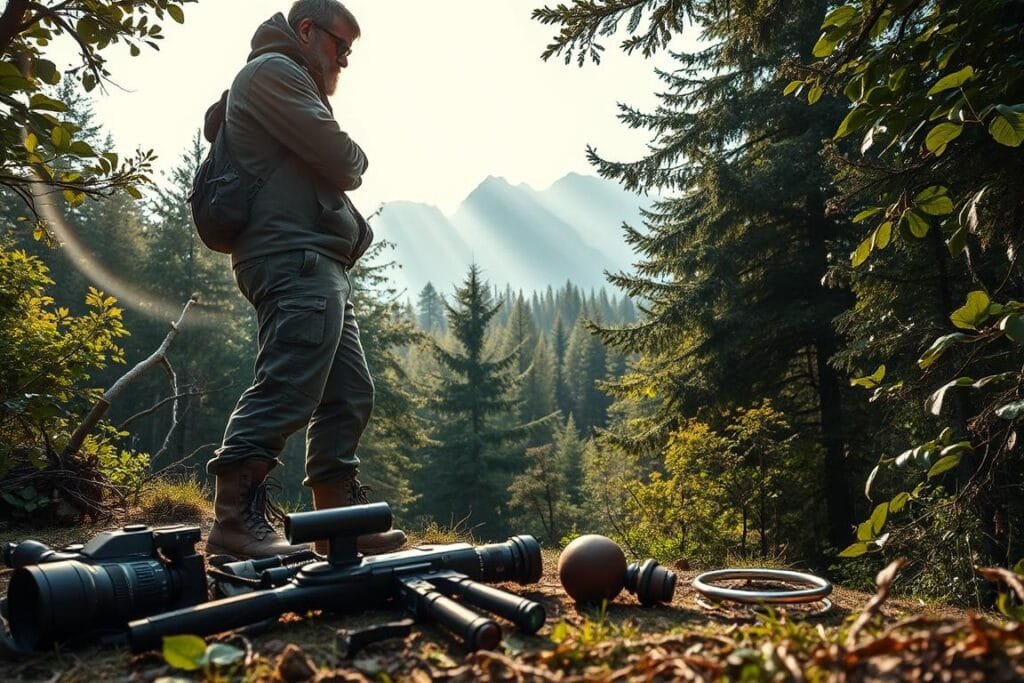
Field Investigations and Modern Technology
Modern cryptid research uses many tools:
- High-resolution thermal imaging cameras
- GPS tracking systems
- Drone surveillance
- Advanced audio recording equipment
These tools help gather data on reported habitats. The aim is to separate stories from verifiable facts.
Engaging Local Communities
Good research needs local help and knowledge. Locals often provide key context about reported sightings.
| Investigation Strategy | Community Involvement |
|---|---|
| Local Interviews | Collecting eyewitness accounts |
| Community Workshops | Sharing research methodologies |
| Citizen Science Programs | Documenting possible evidence |
Collaboration Across Fields
Working together across biology, genetics and folklore studies brings a wider view to studying these stories.
Documented Evidence: What Exists and What’s Lacking
Though solid evidence is hard to find, different kinds of documentation keep sparking debate and curiosity.
Photographic and Video Evidence: Blurry Glimpses of the Unknown
Photos and videos are the most debated cryptid evidence. Take the Loch Ness monster case: the 1934 “surgeon’s photograph” caused a big stir, but was exposed as a hoax in 1994. Similar cases show how compelling visual evidence often falls apart when examined closely.
- Rare photographic captures of possible cryptids
- Video recordings with questionable authenticity
- Analysis of visual documentation techniques
Physical Traces: Footprints and Forensic Challenges
Physical evidence is another debated area. In 1958, huge footprints found in Northern California made the word “Bigfoot” famous. After Ray Wallace’s death in 2002, his family said he had made them as a prank. In 2019 the FBI also released an old file on hair samples it had analyzed in the 1970s, which turned out to come from deer.
“The absence of proof is not the proof of absence.”
Scientific Skepticism: The Ongoing Debate
Despite all the effort, scientists are not convinced. A 2018 environmental DNA study of Loch Ness found no sign of large unknown creatures, but a lot of eel DNA. This shows how hard it is to link fascinating stories with real scientific proof.
As the search continues, these stories remind us how much we still enjoy the unknown.
Cultural Impact of Cryptid Sightings in Society
Cryptids have grown from local legends into cultural icons. They draw visitors and support local economies.
Folklore and Media Representation
Cryptozoology is where old tales meet new stories. Creatures like Mothman and Bigfoot have caught the world’s attention. They’ve been featured in movies, documentaries, and video games.
- Films exploring cryptid mysteries
- Documentaries investigating paranormal encounters
- Video games featuring cryptid-themed storylines
The Mothman Festival in Point Pleasant, West Virginia, draws thousands of visitors each year. It shows how these legends can draw in crowds.
Economic Influences
Cryptid legends have become economic boosts for small towns. Local shops sell cryptid-themed items, and places become tourist spots.
- Specialized museums
- Themed merchandise
- Tourist attractions
Willow Creek, California, calls itself the “Bigfoot Capital of the World” and is home to a Bigfoot museum.
Social Media’s Transformative Role
Social media has changed how we see cryptid stories. It lets people share sightings and theories instantly, and also makes it easier to spread hoaxes.
The Future of Cryptid Research: What Lies Ahead
New technology gives researchers better tools to test cryptid stories.
- Drone surveys in remote areas
- Artificial intelligence to spot patterns in reports
- Environmental DNA sampling
- High-resolution thermal imaging cameras
Potential for Discoveries
Cryptozoologist Loren Coleman often pointed out that some animals once considered legends, like the giant squid, turned out to be real. That is why some people keep searching, even though most cryptids are best explained by misidentification, folklore or hoaxes.
Public Engagement and Citizen Science
Today, anyone can contribute to wildlife research. Citizen science projects and environmental DNA sampling help scientists learn more about the animals that really live in remote places.
The Bermuda Triangle: Disappearances, Myths and What Science Says
Conclusion: The Enduring Mystery of Cryptid Sightings
Cryptid sightings show how strongly stories of hidden creatures grab our attention. Despite modern technology, no cryptid has been confirmed by science.
Montana is a hotspot for Bigfoot reports, and legends like the Flathead Lake Monster, first reported in 1889, and the three-legged Enfield Monster in Illinois still circulate. Yet these stories lack solid proof.
Misidentification and hoaxes explain many of these accounts. Still, the idea of a new species is too enticing for many people to ignore. Stay curious, ask questions and look at the evidence.
FAQ
What exactly is a cryptid?
A cryptid is an animal or creature whose existence is not proven by science. They are part of folklore and local legends. Creatures like Bigfoot, the Loch Ness Monster, and the Chupacabra capture our imagination but lack scientific proof.
Why do people find cryptids so fascinating?
Cryptids spark our curiosity about the unknown. They suggest our understanding of nature is not complete. The thrill of discovery and the mystery of these creatures make them very interesting.
Are there any credible cryptid sightings?
There are many reports, especially of Bigfoot in the Pacific Northwest and the Chupacabra in Texas. None has produced evidence that meets scientific standards, and several famous cases were later shown to be hoaxes or misidentified animals.
How do cryptid investigators research these mysterious creatures?
Investigators use equipment like thermal cameras, drones and audio recorders. They also collect evidence, interview witnesses and analyze footprints.
Why hasn’t science officially confirmed the existence of cryptids?
The main reason is the lack of physical proof. Eyewitness accounts and footprints do not meet scientific standards. Researchers need clear evidence and biological specimens to confirm a new species.
Can cryptid sightings impact local communities?
Yes. Cryptid legends can attract tourists and boost local economies. Willow Creek, California, and Point Pleasant, West Virginia, have turned these legends into cultural and economic opportunities.
What role does technology play in modern cryptid research?
Drones, environmental DNA and tracking equipment help investigate reported habitats. Social media spreads sightings quickly, but also spreads hoaxes.
Are cryptids just myths, or could they be real undiscovered species?
Most cryptids are best explained as myths, hoaxes or misidentified animals. Still, new species are discovered every year, and the giant squid was once considered a legend before it was confirmed.
Source Links
- Skeptical Inquirer: The search for negative evidence
- Wikipedia: List of cryptids
- Britannica: Loch Ness monster
- History.com: The FBI’s Bigfoot file
- Smithsonian Folklife: Mothman of Point Pleasant
- Today: The Mothman legend
- Dominion Post: West Virginia cryptids
- Washington College Review: Bigfoot in American society