On August 15, 1977, Ohio State University’s Big Ear radio telescope recorded a strong, narrow-band radio signal that has fascinated astronomers ever since. Volunteer astronomer Jerry R. Ehman spotted it days later on a computer printout, circled it and wrote “Wow!” in the margin, giving the Wow! Signal its name.
The signal appeared near 1420 MHz, the natural frequency of hydrogen, which many scientists had suggested an alien civilization might use to communicate. It has never been detected again, and its origin is still debated.
Key Takeaways
- The Wow! Signal was recorded on August 15, 1977, by the Big Ear radio telescope
- It appeared near the 1420 MHz hydrogen line
- It lasted about 72 seconds, the time a fixed source took to pass through the telescope’s beam
- Its peak was roughly 30 times stronger than the background noise level
- Repeated searches have never found it again
What Is the Wow! Signal?
The Wow! Signal is a short burst of radio emission that looked very different from ordinary cosmic noise. It remains the best-known candidate signal in the history of the Search for Extraterrestrial Intelligence (SETI).
Signal Characteristics
- Duration of about 72 seconds, matching how long a fixed point in the sky stayed in Big Ear’s beam as Earth rotated
- Intensity that rose and fell as expected for a source passing through the beam
- Frequency close to the hydrogen line, around 1420.4 MHz
- Very narrow bandwidth, less than 10 kHz
The famous code “6EQUJ5” written on the printout shows how the signal’s strength changed over those 72 seconds.
Historical Significance
Narrow-band signals like this are not typical of known natural sources, which is why the Wow! Signal attracted so much attention. Because it never repeated, however, scientists could not confirm whether it was artificial.
The Bermuda Triangle: Disappearances, Myths and What Science Says
Searches for a Repeat
Ehman and colleagues searched the same patch of sky many times with Big Ear. Astronomer Robert Gray later searched for it with other telescopes between 1987 and 1999, including the Very Large Array. None of these searches found the signal again.
The Discovery of the Wow! Signal
Jerry R. Ehman’s Moment
Ehman was reviewing printouts from Big Ear’s SETI survey when he noticed the unusual sequence of characters. His handwritten “Wow!” became one of the most famous notes in the history of astronomy.
The Big Ear Radio Telescope
Big Ear was a large flat-reflector radio telescope near Delaware, Ohio. It ran one of the longest SETI programs in history before the site was demolished in 1998 to make way for a golf course.
| Signal Characteristic | Measurement |
|---|---|
| Detection date | August 15, 1977 |
| Frequency | About 1420 MHz (hydrogen line) |
| Duration | About 72 seconds |
| Peak intensity | About 30 times the background noise level |
Scientific Interpretations
The Wow! Signal has sparked decades of debate. The main explanations include:
- A transmission from an extraterrestrial civilization
- Radio interference from Earth or a satellite
- A natural astrophysical event
The Comet Hypothesis
In 2017, Antonio Paris proposed that hydrogen clouds around two comets could have produced the signal. Many astronomers rejected the idea, pointing out that comets do not emit strongly enough at that frequency and that the comets were not in the right position.
The Hydrogen Cloud Hypothesis
In 2024, a team led by Abel Méndez of the University of Puerto Rico at Arecibo proposed that the signal could have been a sudden brightening of a cold hydrogen cloud, possibly triggered by a powerful flare from a magnetar. In archived Arecibo Observatory data, they found fainter signals with similar characteristics coming from hydrogen clouds. The idea is promising but not yet confirmed.
A Possible Source Star
In 2022, amateur astronomer Alberto Caballero searched the region of the sky where the signal came from and identified a Sun-like star, 2MASS 19281982-2640123, as a possible candidate. Later observations did not find any signals from it.
The Wow! Signal in Popular Culture
The Wow! Signal has become a symbol of the search for life beyond Earth. It appears in documentaries, science fiction stories and even TV shows, and the original printout is one of the most recognizable documents in astronomy.
In 2017, a Wow! Signal reply project even sent messages from Earth toward its approximate location.
Ongoing Searches for Signals
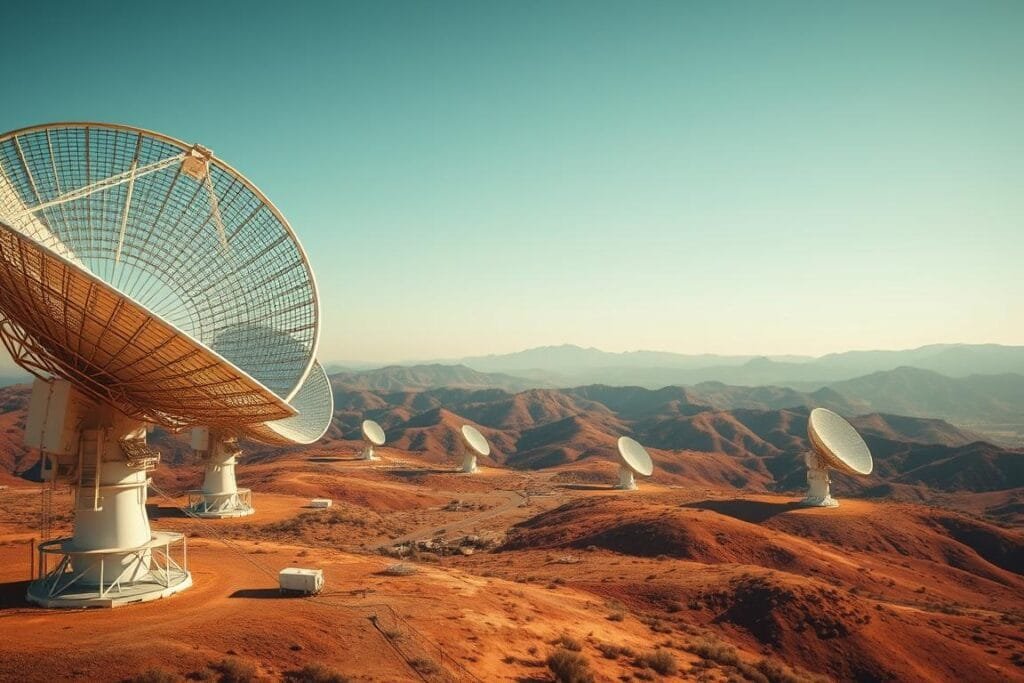
Today, projects such as Breakthrough Listen use powerful radio telescopes to search for signals from nearby stars and galaxies.
- Green Bank Telescope observations in West Virginia
- Parkes “Murriyang” telescope in Australia
- The Allen Telescope Array in California, run by the SETI Institute
Researchers are also developing better ways to tell real signals from interference. In 2023, a Breakthrough Listen team proposed using interstellar scintillation, the “twinkling” of radio signals as they pass through gas between the stars, to confirm that a signal truly comes from far away.
Conclusion: The Legacy of the Wow! Signal
The Wow! Signal is still unexplained almost 50 years later. Whether it was a natural event, interference or a message from another civilization, it remains a reminder of how much we still don’t know about the universe.
Its biggest legacy may be the curiosity it inspires. Every new search builds on the question Ehman asked with a single word: what was that?
FAQ
What exactly is the Wow! Signal?
It was a strong, narrow-band radio signal detected on August 15, 1977, by Ohio State University’s Big Ear radio telescope. It lasted about 72 seconds and appeared near the hydrogen frequency of 1420 MHz.
Who discovered the Wow! Signal?
Astronomer Jerry R. Ehman noticed it on a printout and wrote “Wow!” next to it, which gave the signal its name.
Why is the Wow! Signal so significant?
It is the most famous candidate signal in SETI history because it looked unlike typical natural radio sources. However, it never repeated, so it could not be confirmed as artificial.
Has the Wow! Signal ever been repeated or explained?
It has never been detected again. Proposed explanations include interference, comets and a flaring hydrogen cloud, but none has been confirmed.
Could the Wow! Signal have been a natural phenomenon?
Yes. A 2024 study suggested a sudden brightening of a cold hydrogen cloud, possibly triggered by a magnetar flare, could explain it. The idea is still being tested.