The Bermuda Triangle is one of the most famous mysteries of the sea. Popular books and documentaries claim that dozens of ships and planes have vanished there without explanation, and the region is often called the Devil’s Triangle. Its boundaries are not official, so estimates of its size range from about 500,000 to more than 1.5 million square miles of ocean.
The reality is less supernatural. The area is one of the busiest shipping and flight routes in the world, it is crossed by the powerful Gulf Stream and it is hit by sudden storms and hurricanes. Agencies such as NOAA and the U.S. Coast Guard say that losses there are not more frequent than in other heavily traveled parts of the ocean.
Key Takeaways
- The Bermuda Triangle has no official boundaries; size estimates range from 500,000 to over 1.5 million square miles
- Famous cases include Flight 19 (1945) and USS Cyclops (1918)
- NOAA and the U.S. Coast Guard do not consider the area unusually dangerous
- Storms, the Gulf Stream, human error and heavy traffic explain most incidents
- The region remains an active shipping and aviation route
Introduction to The Bermuda Triangle
Imagine an oceanic region full of legends, where the unexpected seems common. The Devil’s Triangle fascinates adventurers, researchers, and those interested in the paranormal all over the world. It covers a large part of the western North Atlantic.
Geographical Boundaries of Mystery
The Bermuda Triangle is usually drawn between Miami, Bermuda and Puerto Rico. The most common estimate is about 500,000 square miles, centered roughly at 25°N 71°W.
- Area range: 500,000 to 1,510,000 square miles, depending on the source
- Location: Western North Atlantic, between Florida, Bermuda and Puerto Rico
- Nickname: Devil’s Triangle
Historical Context of Vanishing Vessels
The legend grew from a series of real losses that writers later linked together. One famous case is Flight 19 in 1945, when five U.S. Navy planes and 14 crew members disappeared during a training flight.
Despite its scary reputation, the U.S. National Oceanic and Atmospheric Administration (NOAA) says there is no evidence that disappearances happen there more often than in any other large, busy area of the ocean.
Theories Surrounding The Bermuda Triangle
The Bermuda Triangle has long fascinated explorers and researchers. Let’s look at the different theories that try to explain its reputation.
Natural Explanations
Scientists point to several natural factors that can make the area dangerous:
- Sudden storms and hurricanes that form quickly
- The fast Gulf Stream current, which can carry wreckage away
- Rogue waves that can be much larger than surrounding waves
- Deep waters, including the Puerto Rico Trench, where wreckage is hard to find
Some researchers have also suggested methane gas released from the seabed, but there is no evidence of large releases in recent times.
Paranormal Speculations
There are also supernatural theories that have caught the public’s attention. None of them has any evidence behind it:
- Alien abductions
- Time warps
- Interdimensional portals

Human Error and Navigation Issues
Navigation problems are key to understanding incidents in the Triangle. NOAA notes that the area is one of the few places where a magnetic compass can point toward true north rather than magnetic north, which can confuse navigators who do not correct for it.
| Factors Contributing to Incidents | Potential Impact |
|---|---|
| Inexperienced Navigators | High Risk of Disorientation |
| Compass Variation | Potential Course Deviation |
| Weather Conditions | Navigation Challenges |
The U.S. Coast Guard and NOAA say that bad weather and human error are the main causes of incidents, and that the Bermuda Triangle has no special frequency of disappearances.
Famous Incidents in The Bermuda Triangle
A handful of famous cases built the legend. These events still leave the public wondering what happened.
The Vanishing of Flight 19
Flight 19 is a famous aviation mystery. On December 5, 1945, five U.S. Navy torpedo bombers took off from Fort Lauderdale on a training mission and never came back. The flight leader appears to have become disoriented, and the planes likely ran out of fuel over the ocean.
A PBM Mariner seaplane sent to search for them also disappeared. A passing ship reported seeing flames, and this type of aircraft was known for fuel vapor leaks.
The USS Cyclops: A Maritime Enigma
The USS Cyclops vanished in March 1918 with more than 300 people on board while carrying a heavy load of manganese ore.
No wreckage was ever found. It remains the largest loss of life in U.S. Navy history not related to combat.
Other Noteworthy Disappearances
- The Star Tiger airliner vanished on January 30, 1948, with 31 people on board
- The Witchcraft cabin cruiser went missing just off Miami on December 22, 1967
These incidents made the Bermuda Triangle famous, although researchers such as Larry Kusche showed in the 1970s that many popular stories exaggerated or misreported the facts.
Scientific Investigations of the Area
The Bermuda Triangle has long fascinated researchers, who have studied the unique environment that might explain its reputation.
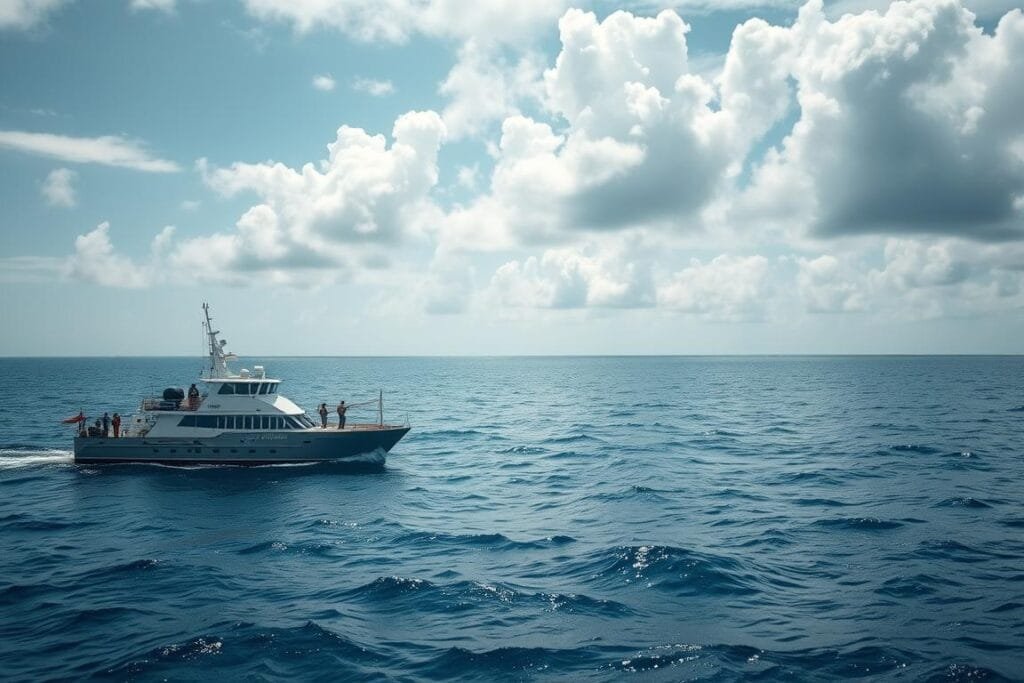
Researchers have looked into several key areas:
- Underwater topography and methane hydrates
- Extreme weather patterns
- Ocean currents
Underwater Phenomena and Geological Insights
The Puerto Rico Trench, at the edge of the Bermuda Triangle, reaches depths of about 27,500 feet, the deepest point in the Atlantic Ocean. Wreckage that sinks there is very hard to locate.
Methane Hydrates: A Scientific Curiosity
Scientists have looked into whether methane released from the seabed could sink ships by reducing water density. Experiments show it is possible in theory, but there is no evidence of large releases in the area in recent history.
Weather Patterns and Environmental Factors
The region sees sudden storms, waterspouts and rogue waves. Combined with the Gulf Stream, these conditions can make navigation challenging and can quickly erase evidence of an accident.
| Research Focus | Key Findings |
|---|---|
| Underwater Depth | About 27,500 feet in the Puerto Rico Trench |
| Methane Release | No evidence of large recent releases |
| Traffic Volume | Heavily traveled shipping lane |
The U.S. Board on Geographic Names does not recognize the Bermuda Triangle as an official name, and scientists keep studying the area with evidence-based methods.
The mystery of the Bermuda Triangle lies not in supernatural explanations, but in the complex interplay of natural phenomena and human error.
Cultural Impact of The Bermuda Triangle
The Bermuda Triangle has grown from a stretch of ocean into a global cultural icon. It has inspired many works in literature, film, and media.
Mysterious Inspirations in Entertainment
Writers and filmmakers love the Bermuda Triangle’s mystery. It’s a rich source for stories.
- Novels exploring supernatural maritime encounters
- Documentaries investigating disappearance theories
- Hollywood films featuring oceanic mysteries
Media’s Fascination with the Unknown
The term “Bermuda Triangle” was coined by writer Vincent Gaddis in a 1964 magazine article. Charles Berlitz’s 1974 bestseller made it a worldwide phenomenon.
Media coverage has made the Bermuda Triangle more than a place. It’s a symbol of the unknown.
Public Imagination and Speculation
Even with scientific explanations, the idea of a mystery at sea keeps people interested. Whether it’s seen as a real mystery or just a story, the Bermuda Triangle connects real events with our imagination.
Are Ships and Planes Still Disappearing?
Accidents still happen in the area, as they do in any busy stretch of ocean. Modern navigation, satellite tracking and weather forecasting have made travel much safer, and most recent incidents have clear causes such as storms, mechanical problems or human error.
The U.S. Coast Guard says most incidents are due to environmental factors and human error. Yet the Bermuda Triangle’s allure endures, and new documentaries and articles keep the legend alive.
FAQ
What exactly is the Bermuda Triangle?
The Bermuda Triangle is a loosely defined area of the North Atlantic between Miami, Bermuda and Puerto Rico. It is known for legends about ships and planes disappearing there.
How many ships and planes have disappeared in the Bermuda Triangle?
There is no official count, because the area has no official boundaries. Famous cases include Flight 19 in 1945 and the USS Cyclops in 1918, which alone lost more than 300 people.
Are there scientific explanations for the disappearances?
Yes. Sudden storms, the Gulf Stream, compass variation, deep water and human error explain most incidents. Methane gas from the seabed has been suggested but lacks evidence.
Has modern technology solved the Bermuda Triangle mystery?
Most researchers consider the “mystery” largely a product of exaggerated stories. Modern navigation and weather forecasting have made the area as safe as other busy parts of the ocean.
Why is it called the “Devil’s Triangle”?
The nickname comes from the legend of strange disappearances. It suggests something supernatural, although no evidence supports that.
Are alien activities a legitimate theory about the Bermuda Triangle?
No. There is no evidence for alien involvement. These ideas belong to movies and books, not science.
Is the Bermuda Triangle more dangerous than other oceanic regions?
No. NOAA and the U.S. Coast Guard say it is not more dangerous than other busy areas. The number of incidents matches the area’s heavy traffic and weather.
What role do methane hydrates play in Bermuda Triangle theories?
Some scientists have suggested that methane released from the ocean floor could reduce water density and sink ships. It is possible in theory, but there is no evidence it has happened there in recent times.
How has popular culture influenced perceptions of the Bermuda Triangle?
Books, movies and TV shows, especially Charles Berlitz’s 1974 bestseller, turned the area into a symbol of supernatural mystery.
Source Links
- Britannica: Bermuda Triangle
- Britannica: What is known and not known about the Bermuda Triangle
- Wikipedia: List of Bermuda Triangle incidents
- History.com: Bermuda Triangle
- Popular Mechanics: What is the Bermuda Triangle?
- Discover Magazine: What science can tell us
- National Geographic
- Newsweek: Do weird things still happen in the Bermuda Triangle?